After the middle of July, the word “Doyou (Saturday)” becomes conspicuous in supermarkets and other stores. Special eel sections are set up, and although the name “Doyou” and “Saturday” are slightly exaggerated, people are still attracted to these sections when they see them.
The custom of “eating eel on the day of the Ox in Doyou” is well known throughout Japan, but originally, “Doyou” is a calendar concept based on the Chinese philosophy of the Five Elements. The five elements are wood, fire, earth, metal, and water, and each of the four seasons is represented by wood in spring, fire in summer, metal in fall, and water in winter, with earth assigned in between. In other words, “Doyou” is the season that comes around at the boundary of the seasons.
In other words, there are four “Doyo” in a year, but today, most people may think of ‘Doyo’ as the “summer Doyo” before the first fall.
In 2025, the summer Doyou period will be from July 19 to August 6, but did you know that there are two “Doyou no Ushi” days?
The “day of the Ox” is the day that falls on the “Ox” of the twelve signs of the Chinese zodiac. In the old days, the days were counted according to the twelve signs of the Chinese zodiac: the Child, Ox, Tiger, and ……. So, during the 18 days of Doyou, the day of the Ox may come around twice. Therefore, this year, the first Ox day, July 19, and the second Ox day, July 31, will be twice in the same year.
Doyou no Ushi (day of the Ox)” is a well-known summer tradition in Japan. This day has become established as “a day to eat eels,” and it is said that the origin of this day is rooted in the theory that it was invented by Gennai Hiraga, a genius inventor and Dutch scholar of the Edo period (1603-1868).
It began in the Edo period when an eel shop consulted with Hiraga Gennai, saying that eels did not sell well during the summer. At that time, people tended to avoid fatty eels in summer, and sales were declining.
Gennai, who was consulted, wrote a sign in front of his store saying, “On the day of the Ox, if you eat foods with ‘U’ in them (eels, udon, cucumbers, pickled plums, etc.), you will not be battered.
Today is the day of the Ox.
That’s all there was to it.
Eventually, other restaurants began to imitate him, and “eels in summer” became the standard.
Gennai Hiraga. It is difficult to describe Hiraga Gennai in a few words.
He was a doctor by profession. But he studied electricity, restored the elektron, wrote novels, directed screenplays, sold medicine, wrote copy, gathered people, and turned the world around.
In today’s terms, he would be an inventor, screenwriter, marketer, and producer.
Still, I am amazed at the marketing sense of Gennai Hiraga that his campaign in the Edo period to “eat grilled eel kabayaki to give you stamina in the extreme heat” has taken root as a year-round event even in this day and age.
Finally, the chorus of cicadas has begun. I am sure everyone is exhausted from the daily heat and humidity, but this is the time to eat foods with the “u” in them that will cheer you up and help you get through the coming extreme heat.
FUKOSHA holds an appraisal session on the 21st of every month.
This month, it will be held on Saturday, June 21st, from 10:00 am ~17:00
No prior notice is required, so please drop by at your convenience.
If you have any items at home or at your parents’ house that you wonder how much they are worth, please bring them in for evaluation only. If you have large items that are difficult to bring in, we will be happy to assess them by photo.
Yesterday was the U.S. League All-Star Game, and I followed the game, although I recorded it so that I wouldn’t see too much information that appeared on social networking sites before it happened. Shohei Ohtani’s bullet foul ball in his second at-bat in the second inning made me yell out, “Woooo! I wonder if it would have been a home run if it had been a few meters to the left.
Now, I’ve been reporting on the “Let’s get excited about summer festivals in Aichi this year, too” blog (I named it as such) in the blog relay recently.
Nakamura Park Summer Festival: Noryo Fireworks Appreciation Party
I have lived in Nagoya for 20 years, but I have never visited this festival. I got this information when I visited a Japanese sweets shop that sells my favorite warabimochi (rice cakes) on the approach to Nakamura Park.
First, let me give you some information about the festival,
The festival will be held on July 23, 24, and 25.
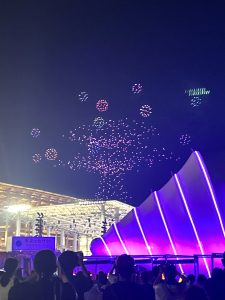
During the three days of the festival, there will be food stalls, events, and Bon Odori dancing, but on the final day, July 25, from 8:40pm to 9:00pm, there will be a fireworks viewing party. In past years, there have been fireworks launches, Niagara Falls, and other fireworks displays. I didn’t know that… I went home and took a good look at this flyer, and I found that the Nagoya Omotenashi Busyoutai will also make an appearance during the three days of the festival, so I feel the seriousness of Nakamura City.
Nakamura Park has a Japanese-style pond, a Japanese garden, and a tea ceremony room. Above all, Nakamura-ku is famous as the birthplace of Hideyoshi Toyotomi and Kiyomasa Kato, and is dotted with historical sites such as Toyokuni Shrine. It is also the birthplace of the Kabuki actor Nakamura Kanzaburo I. The area seems to have a lot of power, which is why the festivals are so serious.
Toyokuni Shrine, located in the park, is a small shrine, but since the area has produced so many famous people, it is believed to be beneficial for success in life and work. Although I myself am not a success in life, I visited the shrine to ask for good luck and success in my career.
I was more interested in the “Senjo Gourd” standing next to the precincts of the shrine, which was swaying lively in the wind, despite the heat of the day. It is so cute that it does not look like a symbol of Hideyoshi’s battle (horse mark), but there were some tags with a motif of this Senjo Gourd in the precincts. I was curious about it, so I looked up Hideyoshi’s horse seal, but it is a gourd, so once you see it, you will never forget it.
It is a horse mark that makes me wonder how he won many battles with it… but at the same time, it also makes me think that one should never judge anything by its appearance… lol. (If you are interested, please check it out.)
In the park, there is also Nakamura Park Memorial Hall (built as a guest house by Aichi Prefecture in 1908 to commemorate the 300th anniversary of Kiyomasa Kato’s death, and where Emperor Taisho, then Crown Prince of Japan, took a rest), teahouses such as Toin Tea House and Hoshoken, gardens surrounding ponds such as Hyotan Pond, Hideyoshi Kiyomasa Memorial Hall with Hideyoshi Library, and a statue commemorating the birth of Kanzaburo Nakamura I. The museum is also home to the Hideyoshi Kiyomasa Memorial Museum, which houses the Hideyoshi Library, and the statue commemorating the birth of Nakamura Kanzaburo I. On top of that, next week we will be watching fireworks, so on the ride home, I was building up a coherent blog in my brain,
Next week, July 23, 24, and 25, is the Nakamura Park Summer Festival.
Well, everyone, have you already gone to a fireworks display this summer? I sometimes get nervous when I hear the sound of fireworks in the distance, but I have no plans yet.
I was surprised to see how many fireworks shows there are in Japan. The number of them is said to be one of the highest in the world.
Fireworks festivals began in earnest in Japan in 1733, during the reign of Tokugawa Yoshimune. It is said that fireworks were set off to pray for the repose of the souls of the dead and to drive out epidemics in the wake of the famine of Kyoho 11.
Therefore, even today, fireworks festivals are said to be held to pray for the repose of the souls of the dead and to make offerings to the spirits of the dead. The famous “Nagaoka Festival” is held as a memorial service for the war dead, and the “Kumano Grand Fireworks Festival” is said to serve as a firework festival to guide and welcome the spirits of ancestors.
While in other countries, fireworks are mainly set off as a celebration, Japanese fireworks are filled with prayers for the repose of the souls of the dead. This may be one of the reasons why Japanese fireworks are described as more delicate and graceful than those of other countries, as if a story comes to mind. We may be very lucky to be able to see such emotional fireworks that move our hearts every year as a matter of course.
We have looked into the fireworks displays that will be held in the neighborhood in the near future.
July 21 (national holiday) Umi no Hi (day of the sea)
Nagoya Minato Festival Fireworks Display
At Nagoya Port Garden Pier, Minato-ku, Nagoya City
Fireworks will be displayed in the night sky with creative starmines created by pyrotechnicians.
July 18 (Fri.) Tezutsu Fireworks, July 19 (Sat.) Fireworks Display
Toyohashi Gion Festival
At the precincts of Yoshida Shrine, Toyohashi City
It is said to be the largest fireworks festival in the Higashimikawa region.
Saturday, July 19
Ogasse Pond Summer Festival
At Ogasse Pond in Kakamigahara City, Gifu Prefecture
This is a fantastic fireworks display held at the mysterious pond where the dragon god sleeps.
The highlight of the festival is one of the largest fireworks display in the Tokai area, with a two-large ball.
After doing my research, I was overwhelmed by the sheer number of fireworks displays. There are so many one after another that there is no end to what I can write.
Where was the thunderstorm last night? I was in the mood to say, “Even if it rains, please go easy on me…. And after the heavy rain, it is very hot and humid in Nagoya today. It is said that high humidity increases the risk of heat stroke, so please take it easy.
As I mentioned in my blog the other day, the “Oochi-wa Kiguri” summer festival is being held from July 15 (Tue.) to 17 (Thu.) again this year at Shiroyama Hachimangu Shrine, which is located near the Antique Art Fumikosha.
Ouchi-no-wa-kuguri, also called “ring-kuguri” or “thatch-ring-kuguri,” is an event to pray for good health, protection from bad luck, and safety in the home by passing through a large thatch-ring set up in the shrine precincts. I am sure there are rings at shrines in your neighborhood during this time of the year.
This is a summer ritual to pray for good health and longevity, to get rid of all illnesses, to get rid of all troubles, to get rid of pestilence and disease, and to be blessed with good health and longevity by the work of thatched grass. Is it just me?
Let’s take a look at how to go through the rite,
First, stand in front of the thatched ring and bow lightly. Then, you cross the ring with your left foot, turn left to the left side of the ring, and return to the original position. Next, you will bow lightly in front of the thatch ring, cross the ring with your right foot, turn clockwise around the right side of the thatch ring, and return to your original position.
Some shrines omit the “bow” after each round of the circle, and instead have people go through the circle three times in succession, as if writing the character for eight, etc. The manners differ from shrine to shrine, so please follow the manners of the shrine you visit. However, I feel as if I make mistakes every year, perhaps because I am in a hurry to get to the shrine as soon as possible when I see someone else in line behind me, lol.
I am afraid that my prayers for good health and longevity, the elimination of all kinds of bad luck, the eradication of epidemics, and health and longevity will not be answered… I am thinking that I might be greedy and start over again.
In addition to the “Oo Kayowa Shinji,” Shiroyama Hachimangu Shrine holds a three-day summer night festival, including the “Akamaru Shinji” to seal away insects from children, the “Kozai Suzuho” to ward off bad luck and protect people from misfortune, and the “Dedo Event” to dedicate lanterns.
The temple grounds are illuminated by lantern offerings, and the festival attracts many worshippers every year as it brings summer to the Yamanote area.
Now that I have done my preparation in today’s blog, I think I am ready to go through the festival in style this year. I will probably be in a hurry, but I will be there on my way home from work.
A few days ago, I heard the chirping of cicadas for the first time this year. The first cicada of the year is called hatsuzemi, which is also a seasonal term for summer.
Every year, during the vague period between the end of the rainy season and the beginning of the rainy season, cicadas can be heard coming from the trees, “Jijijiji…” I wonder if it was the sound of cicadas. I wonder if it is the sound of cicadas…. A few days later, I realize that it is indeed cicadas when a loud chorus begins. This repetition reminds me that cicadas are living creatures that remind us of the passing of the seasons every year.
This year, however, the chorus of cicadas that usually begins at the end of the rainy season has not been heard at all. Many people seem to have noticed this silence, and I have seen many posts on social networking sites saying, “I don’t hear any cicadas this year.
However, the cicada season is originally around late July. Since the rainy season usually ends around this time, it may be that as cicadas, they have come out as usual…. This year, the rainy season ended at the end of June in many areas, and the days were very hot, so it could be said that the cicadas were not singing because the temperature was very high and it felt like summer, but the cicadas were not singing, and people were expecting them to be singing on their own.
Although cicadas are a summer tradition, it is selfish of us humans to think that we would be more grateful if they did not chirp, since the chirping of cicadas raises our body temperature by about 2°C. In fact, some cicadas have actually stopped chirping due to the recent high temperatures.
In the case of the kuma-zemi (black bear cicada), it can only chirp up to 32 to 33 degrees Celsius even in hot weather, and when the temperature exceeds 35 degrees Celsius, it does not chirp as much. Therefore, cicadas are not heard during the daytime when the temperature exceeds 35 degrees Celsius, and may feel that they have stopped singing even more. At high temperatures, cicadas, like humans, become dangerously short on energy and unable to tolerate the heat. No matter how heat-tolerant cicadas may be, when the temperature exceeds 35°C, they may be in a state similar to that of heat stroke in humans.
The sound of cicadas reminds me of when I was a child and would often hear them when I was lying on the tatami mats in my room. When I was playing outside, I was not really aware of it because the sound of cicadas and myself overlapped and became loud background music, but when I stopped moving to take a break, I suddenly heard a pleasant echo. As I doze off, dreaming or not, the cicadas’ chirps become nearer or farther away…. Indeed, when I was a child, the temperature was probably not as high as it is now, so I could hear the cicadas’ voices even during the daytime in mid-summer….
Perhaps in the near future, cicadas will be almost unheard of on the plains, and will only be heard in mountainous areas…. Summer and cicadas have always been associated with memories, but will it be different for children in the future?
When you start to hear the sound of “ming-ming-ming-ming-ming…”, summer is finally here.
When you start to hear the sound of “ming ming ming ming ming ming ming ming ming…” summer is finally in full swing. I can hardly wait until I don’t hear the chorus of the cicadas.