According to what I’ve heard, as of August 26, 2025, there are currently four individuals born during the Meiji era still alive. They are all women, and having lived through the Meiji, Taisho, Showa, Heisei, and Reiwa eras, spanning five different periods, I’d love to hear their reflections on living through all five eras.
Come to think of it, when I was a child, the elderly were born in the Meiji era. I vaguely recall that occasionally, there were even long-lived grandmothers who had been born in the Edo period still alive. This might give away my generation, but when I was a child, my grandmother would tell me things like, “Back in the day, there used to be such-and-such here,” or “Life was like this back then.” At the time, I found it terribly boring, but surprisingly, it stuck with me.
Surprisingly, I find myself curious about those old events and places now. I trace my own memories, piecing things together like, “Oh yeah, she did say something like that…” But it’s too late. Times changed so drastically, there were wars… I wish I’d listened more to those born in the Meiji era, who must have lived through such turbulent times.
My mother, born before the war, also told me many stories from the past. But there weren’t many photos back then, let alone videos. We had to rely solely on her memories. I used to just let stories like “Back then, it was like this” or “That place used to be like that” wash over me. Now I wish I’d asked more probing questions back then. But again, it’s too late.
All these events are just the last hundred years or so in the grand historical timeline, yet they’re packed with each person’s unique history, their personal story. Even within the same era, histories vary wildly. You might dismiss it as an old person’s ramblings and tune out now, thinking it uninteresting. But as time passes, you might find yourself wondering, “Huh, what happened back then?” just like I do. Young folks, you might want to keep the ramblings of the elderly tucked away in the back of your mind for now.
However, someone like me, born in the Showa era, has now lived through three eras. I suppose someday I’ll be treated like a fossil myself, haha.
The Taiga drama “Toyotomi Brothers!” begins airing in January 2026. The title alone sounds intriguing, but the fact that the protagonist is not Hideyoshi but his younger brother Hidenaga makes it even more compelling. Sōsuke Ikematsu plays the role of the elder brother, Toyotomi Hideyoshi, while Taiga drama regular Taiga Nakano takes on the lead role of Hidenaga. The cast also features familiar faces from previous Taiga dramas, including Shun Oguri as Oda Nobunaga. Last week’s episode of “Berabou” was shocking to me, leaving me on the edge of my seat wondering what will happen next. My anticipation for next year’s Taiga drama is already building.
Now, it’s been announced that the stars of “Toyotomi Brothers!”, Ohga Nakano and Shun Oguri, will participate as a special unit in this autumn’s “Nagoya Festival”. They will make an appearance riding in an open-top car. This marks the first time actors from a Taiga drama will participate in the Nagoya Festival.
Date & Time: Sunday, October 19, 2025, 12:45 PM – 1:50 PM
Location: From Nagoya City Hall Intersection to Sakae Intersection
The Nagoya Festival began in 1955. Its main event is the magnificent local heroes parade, centered around the three great heroes of the Sengoku period: Oda Nobunaga, Toyotomi Hideyoshi, and Tokugawa Ieyasu. While former Chunichi Dragons players dressed as the Three Great Heroes participated in the 50th festival in 2004, it’s surprising that no celebrities have joined until now.
In 2022, Takuya Kimura, who played Oda Nobunaga in a movie, appeared as Nobunaga at the “Gifu Nobunaga Festival,” riding a horse and making a dashing entrance, sending the city into a frenzy. Similarly, at the 2023 “Hamamatsu Festival,” Matsumoto Jun, who played Tokugawa Ieyasu in a historical drama, appeared in the mounted warrior procession. The city center overflowed with people eager to catch a glimpse. Hamamatsu City reportedly worked closely with Gifu City, which had coordinated Kimura Takuya’s mounted warrior procession at the “Gifu Nobunaga Festival,” to implement safety measures. This autumn’s Nagoya Festival will likely require even greater focus on safety measures than usual.
Actually, I’ve only ever seen the Nagoya Festival procession on TV, and I’ve always wondered who portrays the Three Great Heroes each year. According to my research, participants have been selected through open recruitment since 1973. The application criteria state: “No restrictions on gender or nationality. Must be 25 years or older and either a resident or employed in Nagoya City.” The individuals selected as the Three Great Heroes for 2025 are all in their 30s, making them the youngest trio yet.
Additionally, three princesses are chosen to pair with each hero: Nohime for Oda Nobunaga, Nene for Toyotomi Hideyoshi, and Senhime for Tokugawa Ieyasu. These princesses aren’t selected through public recruitment but are chosen annually from employees of three department stores. Did you know that? It was news to me, and I was a bit surprised. Nohime is represented by Mitsukoshi, Nene by JR Nagoya Takashimaya (formerly Maruei), and Senhime by Matsuzakaya. Employees from these department stores also participate in the procession.
Besides the Local Heroes Parade, there’s also a Flower Car Parade, the Nana-chan Troop, a float procession, a kagura dance procession, and more. With a total of around 1,000 participants, the parade should be quite a sight to see. Stage events will also be held at various locations throughout the city. Why not add it to your autumn outing plans?
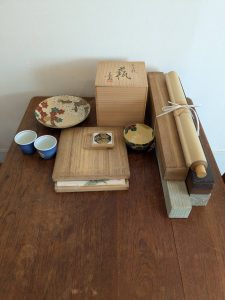
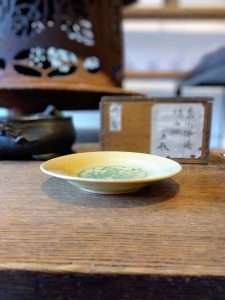
I had the honor of participating in the Nagoya Art Club’s 120th Anniversary Exchange Event. It was an incredibly educational experience.
The Chinese tea and sweets were also delicious.
Now, the Tokyo World Athletics Championships come to a close today, and I feel a sense of sadness. I know I wrote about it just the other day, but please forgive me as my mind is completely occupied by the World Championships right now. Today, on the final day, we’re thrilled as a family to be able to cheer on the Japanese team in the men’s 400m relay final. The 4x400m and 4x100m relay heats were full of upsets, proving that passing the baton in relays presents unique challenges unlike other events. I was shocked by the unexpected elimination of the American team in the preliminaries, but apparently they were the victims of interference and were granted a remedy. They ran again today and advanced to the finals. Indeed, the baton exchanges in the mile relay seemed chaotic with athletes from various countries jostling for position. I thought that’s just how relays are, so I was surprised to hear about the re-run. I guess that happens sometimes.
In the 4x100m relay, other teams seem to be honing their baton-passing skills following Japan’s example, so winning a medal won’t be easy. Still, I really hope the Japanese team, known for their signature smooth baton exchanges, can pull it off again this time.
The National Stadium is packed to capacity every day, and even through the TV, you can hear the earth-shaking roar of the crowd. Japanese athletes consistently comment that they draw strength and express gratitude for the loud cheers. But honestly, I always feel like it’s us who should be thanking them. No matter how much effort athletes put in, many see their hard work go unrewarded in the actual competition. To be honest, I feel like there have been countless moments where it’s the losers, not the winners, who truly moved me.
In the 3000m steeplechase preliminaries, Belgium’s Tim Van de Velde lent his shoulder to Colombia’s Carlos Sanmartín, who was injured after a fall but continued running, helping him cross the finish line. Van de Velde had been leading until mid-race but fell in the water jump, making it difficult to secure one of the top five qualifying spots for the final. Yet, accepting the risk of a yellow card, he ran to Sanmartín without hesitation. It was a moment that showed the bond between athletes, transcending nationality.
Van der Beld, who reportedly broke his collarbone in a crash during last year’s European Championships, stated, “I know what it means to feel helpless when all your effort on the track is wasted in an instant.” He explained that he found himself carrying San Martin without thinking deeply about it. While speaking with reporters, tournament staff approached and showed Van der Beld the yellow card.
The 3000m steeplechase, made prominent in Japan thanks to Ryuji Miura’s performance at this tournament, is also known for its high incidence of injuries during competition. Above all, the “water jump” installed on the track stands out. Many athletes trip here or slip and fall. Beyond the hurdles, many probably wonder why they must jump over a water jump and run soaking wet.
The 3000m steeplechase involves running seven laps of a 400m track. Each 400m lap features four obstacles, including hurdles, and one water jump. Athletes must clear the water jump seven times at a pace comparable to middle-distance running, making it an extremely demanding event requiring both endurance and the ability to adapt to obstacles. The water jump is reportedly 70cm deep at its deepest point and 3.66m long, deeper than I had imagined. Positioning yourself to avoid getting wet as much as possible is crucial.
The 3000m steeplechase is written as “3000SC” in English, where SC stands for “Steeple Chase.” Steepple refers to the spires of churches and such, while chase means to pursue prey or similar. In medieval Europe, members of the privileged classes would ride horses through manors and forests, competing to leap over obstacles like streams and hedges, aiming for the church spires. It is said that commoners without horses imitated this, beginning races on foot themselves. They ran across marshes and pastures, jumping over obstacles, marking the origin of steeplechase racing.
Even so, seeing that water jumps remain part of the event today, one wonders if it’s human nature to find simply running unsatisfying—that obstacles make it more interesting. It’s quite intriguing.
The other day, I attended a piano recital featuring an acquaintance. Having rushed straight from work to the venue, I predictably started nodding off midway through… I genuinely wanted to listen, but before I knew it, my eyelids were closing—I must have been dozing off. (My apologies…)
This tendency to feel sleepy during classical music, for instance, seems to stem from the autonomic nervous system settling into balance and the body and mind relaxing. Particularly with classical pieces featuring gentle tempos and melodies, the rhythm can induce alpha waves or stimulate the limbic system, triggering the release of serotonin—often called the “happiness hormone.” This serotonin then becomes the raw material for melatonin, the sleep hormone. Additionally, the pleasant swaying motion and the ambiguity of the musical structure can sometimes make it hard to follow the context as you listen, causing your consciousness to drift away. All these factors combined seem to have the effect of inducing a comfortable sleep.
Well, that sounds like a classic “What can you do? lol” justification. But falling asleep could also be seen as proof of how deeply soothing the music is. And as long as you’re not snoring, I’d like to think it’s not disrespectful to the composer or performers. But really, it’s all just excuses.
However, it seems there are concerts lately that overturn this “it can’t be helped” notion. Classical concerts are being held where you can enjoy the performance while relaxing in reclining chairs, hammocks, beanbag cushions, and other comfortable seating, sipping alcohol or soft drinks, nibbling on snacks, and chatting with your companion. Tickets seem to sell out every time.
So, everyone just wanted to lie back—or seriously fall asleep—munching on snacks while listening to classical music…? Haha. It’s a bit reassuring to know there are quite a few people like me. But imagining the performers in tuxedos and long gowns on stage seeing the slumped audience below… well, it leaves you with an indescribable feeling, doesn’t it?
But honestly, for us audience members, being able to hear live classical music in any style is such a luxury… I’ll take the liberty of assuming the stage and the audience seats exist in separate dimensions. I’d love to go at least once—to listen? Or to sleep?
Currently, it seems three typhoons have formed in the seas south of Japan. While many typhoons have formed near Japan this year, few have actually made landfall. However, the damage from tornadoes and linear precipitation zones seen in news footage is more severe than anything I’ve witnessed before, making me feel that the Earth’s climate is indeed different from what it used to be.
The tornado that struck Shizuoka Prefecture on September 5th was caused by the approach of Typhoon No. 15, and it caused tremendous damage. Even when I saw tornado warnings on TV news flashes, I tended to think, “Well, it’ll probably be fine,” and underestimated the risk. But seeing the damage in footage forces me to reconsider. While seeing is believing, the images of cars being lifted into the air and flipped over in an instant, or houses with shattered windows and rain pouring inside, leave me speechless at the sheer power. Just yesterday, there was also damage from strong winds in Ibaraki Prefecture.
In American movies, you often see people rushing to shelters when a tornado hits, but I’d assumed Japan didn’t get tornadoes that big. However, it seems we need to be fully prepared for strong winds and tornadoes from now on. Signs of an approaching tornado include thunder and lightning, a sudden cold wind, and low, dark clouds moving in. If you sense these signs, it’s crucial to seek shelter in a sturdy building and stay away from windows and walls.
Recently, there was shocking news about severe flooding in Mie Prefecture caused by a linear precipitation zone, where approximately 270 cars were submerged. This isn’t just someone else’s problem for other urban areas with many underground facilities; countermeasures are urgently needed. Hearing stories about people trapped underground, unaware of the situation above ground until it was too late to escape, makes me realize this could happen to anyone and is terrifying. I wish we could detect areas where linear precipitation zones might form even a little earlier, but since we’re dealing with nature, pinpointing exact locations seems difficult.
Around this time last year, I posted a blog about the Himawari weather satellite. Learning that Himawari, having completed its mission, would continue drifting in space without returning to Earth was quite a shock. Since 2022, observations have primarily been handled by Himawari-9. Himawari-10 was scheduled for launch in 2028 to take over observations in 2029, but it was announced that the launch has been postponed to 2030. The delay is reportedly due to the slow development of a sensor expected to significantly improve linear precipitation zone forecasts. This sensor can apparently measure things like water vapor content in three dimensions. Expectations for Himawari-10 are certainly growing.
However, there are also concerns. While Himawari-9’s cameras are designed to last eight years, it will reach its eighth year in 2030, raising questions about durability. In fact, last November, its infrared imagery became distorted and couldn’t display properly for about half a day. I vaguely recall something like that happening… Will the handover be a close call?
It’s hard to imagine weather satellites becoming unusable, but it seems we can seek assistance from other countries in an emergency. In the past, when Himawari-5’s launch was delayed, they rented an American weather satellite. It actually orbited Japan’s path for two years, delivering images to us.
We’re protected by various technologies we don’t even know about. I’m quietly rooting for the technological development of Himawari-10.
September is already drawing to a close. It’s still hot here in Nagoya, but it feels like I’ve been wearing short sleeves for nearly half a year now. Should I buy new short sleeves, or should I just make do with what I have until long sleeves are needed… The question of what to wear in September and October is starting to arise for me.
By the way, the other day I came across an ancient literary work describing daily life on September 20th, roughly 700 years ago.
It’s Yoshida Kenkō’s Tsurezuregusa, written around 1331 during the late Kamakura period. Within it, there’s a passage describing September 20th (by the old calendar) nearly 700 years ago. One section is titled “Around September 20th” (Section 32), and the title itself is the date.
Around the twentieth day of the ninth month, I was invited by someone and went moon-viewing until dawn. Something came to mind, so I had them guide me, and I entered. In the overgrown garden, the thick dew and the unforced fragrance wafted softly, creating a hidden atmosphere that was profoundly moving.
Though he left at a good hour, I still felt the tenderness of the moment and watched from my hiding place for a while. He pushed open the sliding door a little more, as if to view the moon. Had I rushed in then, I would have spoken out of turn. How could I have known someone was watching from behind? Such matters depend solely on one’s vigilance day and night.
I heard that person soon disappeared.
This is the passage.
Simply put, on the night of the full moon in late autumn, around the 20th of September, two people were enjoying moon viewing together. Kenko and his acquaintance visited a certain person’s house. While waiting, Kaneko observed the house: the garden was untended and overgrown, yet carried a natural fragrance. Such details seemed to deeply resonate with him. What impressed Kaneko even more, however, was the owner’s demeanor, leading him to watch the person for a while.
It’s truly a casual, rambling account, simply recording the everyday life of the Kamakura period without any particular focus. Some readers might feel a sense of kinship, thinking, “Even people 700 years ago had sensibilities similar to ours…” while others might admire, “Well, that’s Kenkō for you! It’s that uniquely first-rate perspective only he could have.”
By the way, did you assume the person being observed was a woman? I myself had assumed so, but actually, the original text doesn’t explicitly state that the observer is a “woman.” Many modern translations seem to imagine a woman, conjuring an image of quiet, ephemeral grace, but the truth is, who this person was, where they came from, and what they were like remains a mystery.
As autumn nights grow cooler, why not take on the challenge of solving this mystery from Yoshida Kenkō, who lived over a thousand years ago?
The Tokyo 2025 World Athletics Championships, which opened on September 13th, have been making headlines daily. Since it’s being held in Japan, the viewing times are convenient for us, but I can’t help but worry about the athletes competing in events after 10 PM—isn’t that too much of a burden?
Even so, the physical abilities of the world’s athletes are simply astonishing. Yesterday, Kenya’s Faith Kipyegon won gold in the women’s 1500m. Despite her petite frame at just 157cm tall, she dominated the race with an overwhelming performance, leaving no room for others and carrying the air of someone who simply belonged in first place. After crossing the finish line, while other athletes collapsed, she was seen smiling brightly and cheerfully, showing concern for her fellow Kenyan competitor. Her charming demeanor instantly won me over as a fan. I’m looking forward to seeing her battle it out with the Japanese athletes in the 5000m.
And then there’s the pole vault, which always gets me hyped (or is it just me?). This time, Sweden’s Armand Duplantis cleared an incredible 6m30cm, setting a new world record. He also achieved the remarkable feat of winning the event for the third consecutive Olympics. It’s a sport I could never do myself, but I love how it makes me feel like my own body is floating along with the athlete. The exhilaration when they clear the bar is truly special. Even if it’s just a mental simulation. Watching the pole vault always makes me wonder what ability is most crucial for this sport. Muscle and flexibility are obviously necessary, but I can’t shake the feeling there’s some hidden special talent involved.
Also, during the recent pole vault final, the sense of camaraderie among the athletes was strong. Though rivals, they felt more like comrades striving together to reach new heights. When Duplantis broke the world record, seeing the other athletes rush over, embrace him, and celebrate wildly nearly brought me to tears. Maybe it’s my age… I find myself wishing this spirit of sportsmanship could permeate everything.
While glamorous events like the 100m are certainly intriguing, personally, I find myself worrying about false starts so much that the race feels over before I know it. After all, a false start means instant disqualification. Moving within 0.1 seconds of the starting signal constitutes a false start. This rule is based on the medical fact that it takes humans at least 0.1 seconds to react to an external stimulus. Moving within 0.1 seconds is considered moving before hearing the starting gun. However, there are studies suggesting that with training, reacting within 0.1 seconds might now be possible.
The judgment of a false start is now made using a false start detection device attached to the starting blocks. Sensors detect even slight changes in pressure. That long tube attached like a tail behind the starting block is likely this device. This equipment is reportedly made by Seiko. While Japan doesn’t win a large number of medals, it makes me proud to think that Japanese technology supports fair competition.
Incidentally, the starting signal apparently doesn’t come from a pistol. This is to account for the time lag before the sound reaches the athletes. The actual starting signal comes from speakers at the athletes’ feet or within the track. To ensure fairness, the technology has advanced this far.
Even so, since no athlete deliberately false starts, witnessing the disqualification is painful to watch. The sight of a referee approaching an athlete at the starting line to declare a false start seems cruel, but it’s probably unavoidable for the sake of fair competition. Until 2002, a second false start led to disqualification. However, this led to more athletes taking a gamble at the start, so from 2003, a single false start resulted in disqualification. Many will remember when Usain Bolt, hailed as the fastest man alive, was disqualified for a false start in the 100m final at the 2011 championships. It really brought home the intensity of a race decided by thousandths of a second.
At this Tokyo meet, a rare occurrence?—a false start in the men’s marathon—also happened. While comments flooded in saying there was no need to panic, considering the athletes’ seriousness, it’s no laughing matter.
I’ll be enjoying the World Athletics Championships for a while longer.